
The Reliable Gardener
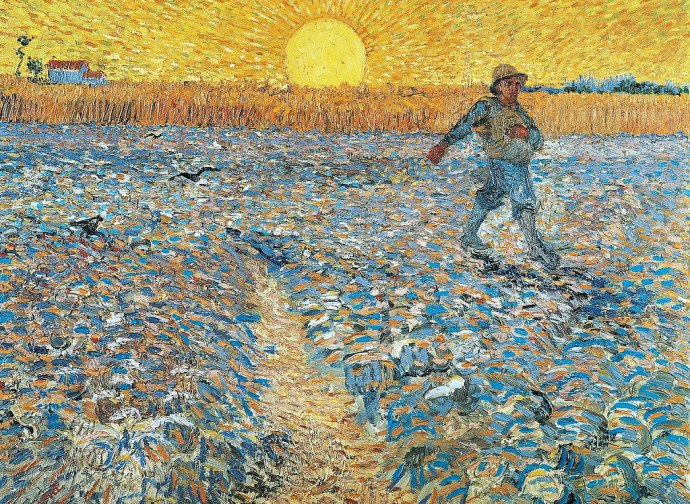
The Sower, 1888 painting, by Vincent van Gogh.
Tracy Daub
7/16/23—University Presbyterian Church
Isaiah 55:10-13; Matthew 13:1-9, 18-23
THE RELIABLE GARDENER
This is the season when a lot of us are attempting to grow things in our gardens. Maybe its flowers. Maybe its tomatoes. In today’s scripture readings we are told that God is also engaged in planting and growing. But instead of tomatoes or flowers, what God is planting is, we are told, God’s word. God’s word is what is being sown and grown.
When we speak about God’s word, we really mean God’s message of love, mercy, compassion, and justice. These are the seeds that God sows: that we know we are loved and forgiven and cherished by God—that is the seed; that we learn how to imitate God by extending love, mercy, compassion and justice in our lives and world—that is the seed. This is what is meant by “God’s word.”
In the Parable of the Sower, Jesus tells about a farmer who scatters seeds broadly and widely across the field. And the seeds land on different kinds of soil which then influences how well they flourish. Good soil means good growth. Poor soil, rocky conditions, means crop failure.
When Jesus’ gives an explanation of this parable, he explains that the seeds are the word of God. Sometimes God’s word lands on good soil and yields extraordinary growth, and sometimes God’s word lands on soil that is in poor condition where not much if anything can grow.
Now I wonder if you are like me in how you have interpreted this parable. I have often received this parable as a lesson about my need to become good soil. Maybe that is how you have heard this story as well. Christians have also read this parable as an explanation as why some people are believers and others are not—as if we could point to some people and determine that they are good soil people or bad soil people.
But notice, that the parable is not called The Parable of the Different Soil Types. Jesus
himself refers to the story as the Parable of the Sower. This parable is all about the Sower. This parable is about the generous ways God scatters God’s love, compassion, and mercy without calculating where it will land.
And how differently would we hear this parable if we considered that the different soil types are not necessarily different kinds of people, but that instead the different soil types exist within each of us. Sometimes we are receptive to God’s word. Sometimes God’s love, mercy, and compassion find a receptive place to grow within our lives and we become people who share love, offer forgiveness, extend compassion, work for justice. And sometimes, hardships, anger, or grief make it hard for God’s message to take root. And sometimes selfishness, materialism, and pride choke the message of God from our hearts and souls. But remember: this is the Parable of the Sower. So this parable has something to teach us about God. And what we learn is that God sows the seeds of life with radical abandon. Maybe your soil is not receptive today. But that doesn’t stop the sower. Our generous God will be back tomorrow and the next day and every day, sowing the seeds that make for life.
And that is because God is on the side of life. Always. God is on the side of your life, always. God is on the side of the things that will bring forth life. Farmers—sowers of seeds— are in the life-growing business. They grow plants. They are all about helping things come to life. The Sower anticipates life with every handful that is thrown out into the field. And so God returns each day in your life, in our church, in this world to scatter generously with the expectation of bringing forth life. If the seed does not land on good soil today, we can trust that the Sower of life will return—tomorrow, and the next day, and every day—to do the work of sowing the seeds of life. Love. Mercy. Compassion. Justice. Generosity. Hope.
The prophet and the poet Isaiah had a bit of a challenge on his hands when he wrote the words we read in our other scripture today. Isaiah was speaking to people whose soil was not very receptive to God’s word at that time. And that is because they were filled with a lot of sadness and grief. The Jewish people had been taken captive by the Babylonians and were now living in exile far from their homeland. It was a time of tremendous despair. Isaiah poetically describes their lives as being filled with thorns and briers—prickly and painful things. The people were grieving a loss. They were enduring a hardship. They were distressed about their present and in despair about their future. And they weren’t even sure they believed in the God of their ancestors any more.
Does that resonate with any of us here today—maybe about our personal lives or for our congregation, or for our world at large? When faced with changes we do not welcome, struggles and challenges in the present, a future that seems scary or uncertain, our garden may seem overrun with thorns and briers.
Isaiah writes to his people in their time of hardship to renew their sense of trust in the God who is on the side of life. In other words, he wants to help amend their soil. Isaiah talks to the people about God’s word that is planted in their lives. The prophet reminds the people that in a world of uncertainty, God’s word is reliable. He reminds them that in a world of loss and grief and unwelcome changes, God’s word is steadfast. He reminds them that in a world of death and death-dealing powers, God’s word creates life.
Eugene Peterson’s paraphrase of this Isaiah passage in his book The Message gives us a fresh way of hearing this message. God is speaking to the people:
“Just as rain and snow descend from the skies and don’t go back until they’ve watered the earth, doing their work of making things grow and blossom, producing seed for farmers and food for the hungry, so will the words that come out of my mouth not come back empty-handed. They’ll do the work I sent them to do, they’ll complete the assignment I gave them.”
God’s word has an assignment. Love has an assignment in your life. Mercy and compassion have an assignment in your life and in this church. Hope and justice have an assignment in this community. They have an assignment to carry out in you and your life, and in this church, and in our world. Isaiah tells us that God plants this word in our lives and has every expectation that they will complete the assignment.
You here at UPC have been and will continue to be the soil where God’s word is planted and where God’s assignment is fulfilled. You, in your personal life, have been and will continue to be the soil where God’s word is planted and where God’s assignment is fulfilled. Some days our soil is more receptive than others. But we can count on the reliability of the Sower, the One who keeps scattering love, hope, compassion, mercy upon us, and who calls us to do likewise.God will not let God’s word return empty handed. God scatter the seeds of life with extravagant generosity. And in place of thistles and thorn bushes, your life and the life of this congregation become the signs of the beautiful things God is growing.