
Standing on Tip-Toe
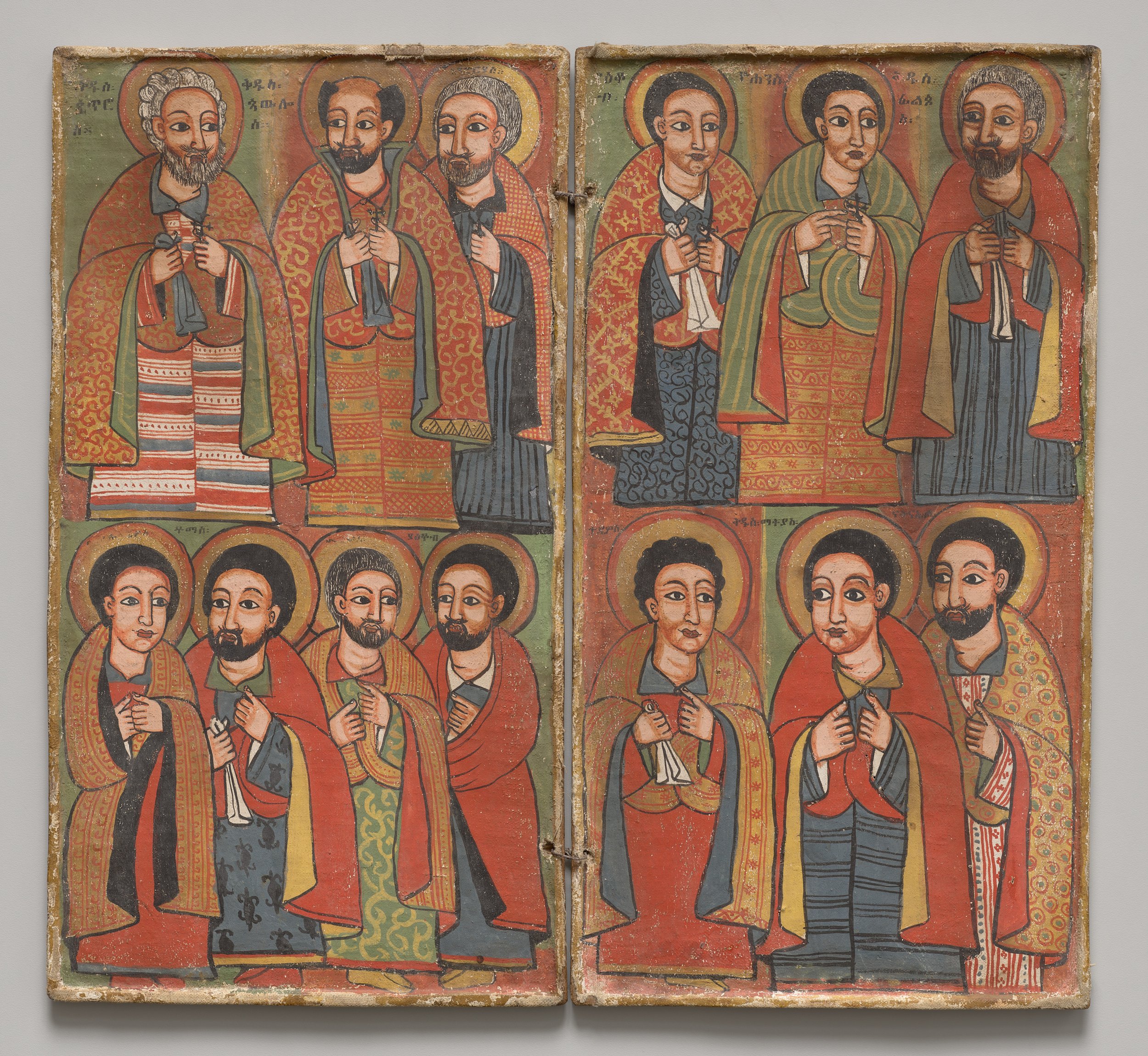
Diptych with Twelve Apostles & Saint Paul, Ethiopia, late 17th-early 18th century artwork.
Tracy Daub
7/23/23—University Presbyterian Church
STANDING ON TIPTOE
Today we are going to consider the topic of hope. But before we talk about hope, we are
going to talk about groaning. We are following the lead of the Apostle Paul who writes to the
community of believers in Rome about hope, but first he begins by talking about groaning.
There are various reasons why we groan. There are groans that arise out of pain and
suffering, loss and grief, bad news and personal disappointment. We open an email and receive
unwelcome news and we groan. We endure physical pain from which we can find no relief, and
we groan. Groaning may surface in the darkness of the night as we feel overcome by our grief
from the loss of a loved one. Perhaps it is our own misdeeds which prompt us to groan as we
contemplate with shame or regret something we said or did.
The conditions and circumstances of our world may prompt us to groan. When was the
last time the daily news elicited a groan from you? Was it the report of another mass shooting?
Or the rulings of the Supreme Court? Or the laws enacted by state legislatures affecting the lives
and health of women? Whole groups of peoples groan under the weight of oppression and
injustice. A friend’s transgendered son decided to stay home from a family reunion taking place
this summer in another state because the laws of that state prevent him from using the restroom
that matches his gender identity.
The Apostle Paul even speaks about creation groaning. And we certainly are witnesses to
that taking place. The life-threatening heat wave across our nation, the smoky air we have been
forced to breathe this summer, the droughts, the flooding, the hurricanes—these all are the
sounds and sights of a planet groaning under oppressive and unsustainable conditions. The
Apostle Paul tells us that it is not only us humans who groan from our sufferings, but that
creation itself groans as it longs “to be set free from its bondage to decay.”
Our groans are really an expression of the pain we feel that the way things are do not
match the way they should be.
The Apostle Paul listened to our groans and the groans of creation and he heard
something lodged within that sound. He heard hope. Paul compares our groaning to a woman in
labor. There is great pain and suffering for sure, but there is also lodged within that groan, a
hope in something new coming to life. So it is, says Paul, that we groan in expectation of God’s
redeeming, healing, life-giving work among us, within us, and around us.
And so, we finally come to the topic of hope. Groans we understand. But hope, hope is a
more difficult thing to comprehend. First of all, what is hope? Because hope is not the same as
optimism. Optimism is rooted in a cause and effect kind of thinking. We can draw optimistic
conclusions about the future based on experiences or facts or circumstances in the present or the
past. Since “this” happened, we can reasonably conclude that “that” may happen. Optimism was
on display in the Buffalo Bills banner I saw hung in a local restaurant which simply stated
“Billieve.” We can “Billieve” in our hometown team because of any number of factors: good
trades, strong players, capable coaches, past performance. While there are no guarantees, we can
be optimistic.
But hope is not the same as optimism. Hope exits irrespective of discernable factors or
circumstances. A person may have hope even when there is no evidence to indicate a better
future or a change in circumstances.
The American poet Emily Dickenson wrote that:
“Hope” is the thing with feathers -
That perches in the soul -
And sings the tune without the words -
And never stops - at all –
Dickenson gives us the image of hope as something that is simultaneously fragile yet persistent.
I heard the great preacher Fred Craddock once remark that hope can exist on one calorie a day.
And he shared the story of a group of women held in a Nazi concentration camp who, though
emaciated from starvation and disease, were forced each day to march to rock quarry to do
manual labor with nothing but their bare hands. And how they would encourage each other by
saying, “today we get to pass the house with the red geraniums.” Hope can exist on one calorie a day.
Maybe you’ve had that experience of hope in your life—where hope is both a delicate yet determined presence, able to survive on almost nothing.
And even as we groan with longing, we don’t really know what we are hoping for
because we can’t see it. That’s what the Apostle Paul reminds us: that hope that is seen is not
hope. Our approach to hope is like a very small child at a parade, standing on tiptoe, straining to
see what is coming down the road. She doesn’t even know what is coming—she can’t see it—
yet she anticipates it will be something wonderful.
Paul invites us to stand on our tiptoes and look down the road. To have hope. Our hope
is not rooted in cause and effect—which is optimism. Our hope is not rooted in ourselves or our
own abilities—which is an exercise in futility. Paul tells us our hope is in the redeeming
presence of God for us and for all creation--that God is growing something from our labor pains,
bringing forth something new, something healing, something life-giving for us, in us, and around
us in this world.
We need to pay attention because this wonderful thing God is birthing is not likely to
match our expectations. It may be tucked away inside the ordinary moments of our ordinary
day: a gesture of reconciliation from someone with whom we have a strained relationship, a
word of kindness at a time when we are feeling especially low, a cooperative gesture between
political leaders on different sides of a divisive issue. God’s wonderful acts of redeeming work
take many forms.
Paul tells us to have hope in the redeeming work of God. To wait with hope.
But we do not wait passively. Here is an interesting thing Paul says: Paul writes that all
creation waits with eager longing for the revealing of the children of God. If I understand that
sentence correctly, Paul is saying that creation—that means everything that lives and breathes
upon this planet—that creation is waiting for the children of God—you and me—to reveal
ourselves.
So how do we reveal ourselves? We reveal ourselves to be the children of God when we
work to alleviate the groaning of everything and everyone in this creation. That is, after all, what
Jesus showed us, right? Jesus taught us that we will be called children of God when we include
the outcast, heal the sufferings of others, forgive one another, love our enemies, give generously,
work for peace. God listened to our groaning and came to us in Jesus with healing, redeeming
love. And Jesus tells us over and over again to follow his example: feed my sheep, love one
another as I have loved you, do this in remembrance of me. We reveal ourselves to be children
of God when we listen for and respond to the groaning of all of God’s creation.
How I wish I could say that all of our groaning will result in a happy ending—at least the
endings we want to happen. But we know this is not true. We do not always get the happy
ending we want. The cancer is not always cured. The marriage is not always saved. The leaders
of the world do not always cooperate to make peace, end a war, and stop the killings. For now, we groan and we wait, and we strive to live in ways that reveal ourselves to be children of God. And in all of this, we have hope in the faithfulness of God’s redeeming presence giving birth to something new—even while we do not know what that looks like. So we stand on our tiptoes, looking down the road for the unknown wonder God is sending our way.