
Hidden Treasures
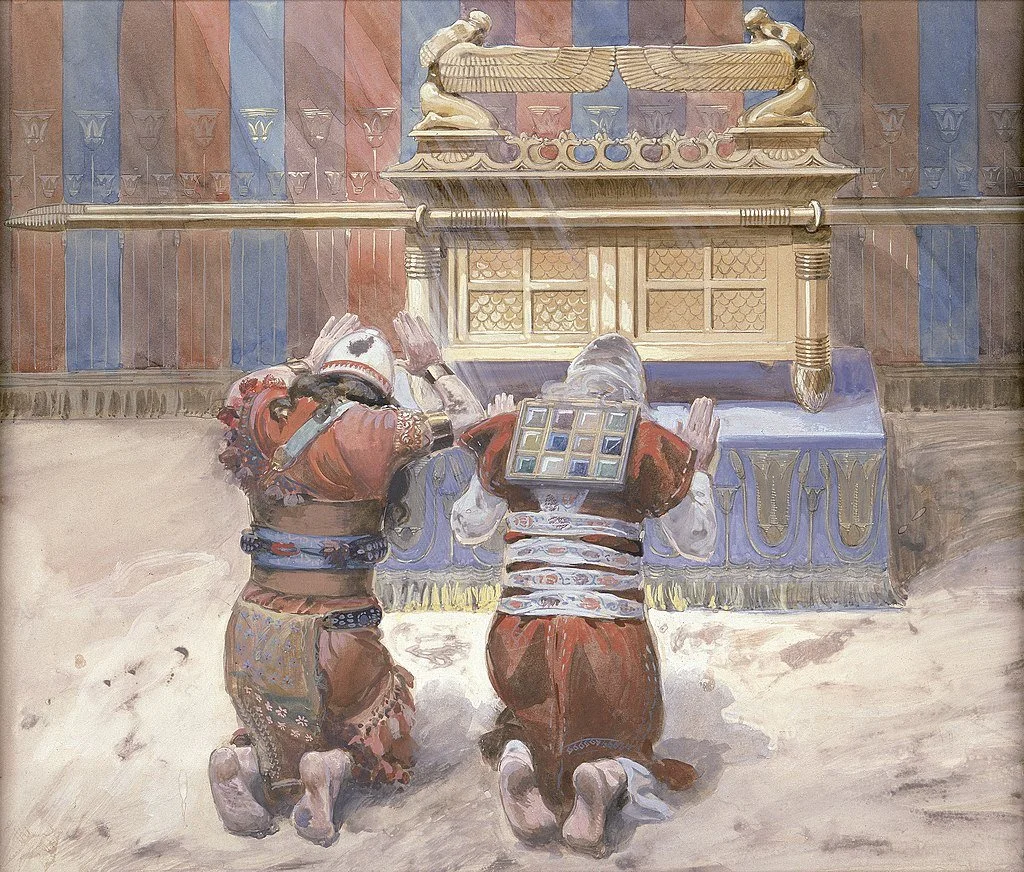
Moses and Joshua bowing before the Ark, 1900 painting, by James Tissot.
Tracy Daub
7/30/23--University Presbyterian Church
HIDDEN TREASURES
I imagine Jesus smiling as he told his disciples this series of parables about the kingdom of heaven because he knew how astonishingly ridiculous they would seem. His disciples were quite familiar with kingdoms. After all, they lived under the domain of the Roman Empire. We today may not live under a monarchy but we have a pretty good idea from history and fairy tales what kingdoms look like and act like. Kingdoms are powerful. Kingdoms are hierarchical— with a few people at the top in control and the rest serving as lowly subjects. Kingdoms function through a system of domination. A kingdom needs to make its presence and power obvious to its subjects if it is to rule with any success.
But Jesus leads us to believe that the kingdom of heaven, the domain of God, functions in a radically different way than earthly kingdoms. These short parables he tells about the kingdom of heaven are like a sampler patter of little tiny appetizers. Jesus holds out the platter and then smiles as we taste first one, and then another, and he watches our surprise, our puzzlement, and sometimes our delight at what we discover with each tiny bite.
The kingdom of heaven is like a mustard seed that someone planted in a field? This is a ridiculous illustration for the kingdom of heaven! Mustard plants were invasive weeds. Imagine if Jesus were to say to us today, “the kingdom of heaven is like a dandelion seed which the gardener plants with great care and it grows into the most beautiful flower of the garden.” We would immediately get the absurdity of this parable. Jesus had to have had a fun time telling that story to his disciples. But what might this absurd story reveal to us about the kingdom of heaven? That God’s realm grows beyond our control—like a weed. That God’s realm grows into something beautiful, but which does not match the world’s standards of beauty. That God’s realm is something subversive—invading the world with its power of love and grace and justice in ways the world cannot control.
Each of the following parables about the kingdom of heaven is similar in its power to shock and surprise. The kingdom of heaven is like yeast a woman worked into her dough to make bread. Yeast was not only a mysterious ingredient with the capacity to enlarge and grow and expand, but it was also understood in Jesus’ day to symbolize a corrupting influence. So the kingdom of God is this small, hidden, expanding force upon our lives with the power to corrupt the world and our lives in service to God’s ways. Enter the realm of God, and you are changed, corrupted if you like, forever.
Or the kingdom is like a treasure hidden in a field or a pearl of great value which prompt the finders to go to extraordinary measures to possess that treasure. Or it is like a net cast out into the waters to catch every kind of person.
What we learn from these parables is that the kingdom of heaven is really not a place but a condition—a condition of the human heart, the human mind, the human soul. These parables reveal how the kingdom of God functions in this world—in ways that are hidden and not obvious to the untrained eye. And yet there it is all the time—like a treasure in a field, waiting to be discovered.
As I reflect on my 21 years here at UPC, what rises to the surface of my mind are the ways I have discovered the kingdom of heaven showing up here. Like how our congregation responded to help Norma as her health and abilities declined. Norma was a member of our congregation who never married, had no children, and no living relatives. But as she advanced into her eighties, it became apparent to some members here that she needed some help. So a loose system of church members stepped in to become her support network. One member helped her pay her bills and manage the details of daily living. Others drove her to appointments. Others visited her when she was in rehab or later in hospice—even bringing their dog along for the visit to brighten Norma’s day. Norma wasn’t always an easy person to work with. She could be ornery. She wasn’t always compliant. Sometimes her decisions were not what we might consider wise. And we had to balance a respect for Norma’s autonomy with our desire to assist her. The extent to which this congregation went in its care for Norma was not typical of most congregations. At one of Norma’s medical appointments I explained to the medical staff that those of us accompanying her were not family members but were members of her church. And the nurse asked with astonishment, “Now what church is this?”
The members of UPC offered similar care to Joe Maiwald and Donna Riddaugh, helping them when they became ill, interfacing with hospice on their behalf, taking shifts at their homes when they lay dying.
Members of this church have driven one another to appointments, knitted shawls for those dealing with illness or grief, even helped a member take a shower following surgery. UPC members have extended themselves to help new immigrants in our community— assisting them in finding the services they needed, helping them navigate the bureaucracy, making them part of our own families.
This church has endeavored to live out the love of God to all who walk in our doors—not always perfectly but with a sincere effort to try--including those who show up asking for money, those challenged with mental health issues, those who come to our Food Pantry.
None of these activities make the newspaper headlines. These are largely hidden from view and garner little attention. But for those with the right insight, these endeavors are the hidden treasure in the field, the pearl of great value.
When a racist-inspired atrocity took place in our city, this church reached out to bridge divisions, to form friendships across Buffalo’s racial divide by forging a partnership with another congregation. This is the subversive activity of the kingdom of heaven. It is subversive when we challenge the status quo and even our own comfort by learning about racism and our unconscious role in its existence, and by saying we want to do something about it.
It is the subversive activity of the kingdom of heaven when members of this church persistently hold up the realities of injustice, the plight of migrants, the exclusion of LGBTQ people, the injustice found within the mass transit system, the urgent need to address gun violence.
We have not always lived out the kingdom’s values. But even in our failures, the kingdom’s invasive weed-like activity still persists among us. I’ve witnessed how this community has helped one another do a course correction at times. With patience, members have guided this church to take important stands toward inclusion and acceptance and justice. Recently, when I failed to adequately respond to an individual who had come to our church doors for help, one of you stepped in to offer a cup of cold water to one of God’s children. This is how we live out the kingdom’s values together—stepping in to model the kingdom’s values, guiding one another, learning from each other.
One member of this congregation always humbles me in the way she is attentive to the least of God’s children. And she inspires me to think, “I want to be like her when I grow up!” That’s how the yeast of the kingdom of heaven works—when we witness it working in other people’s lives it corrupts us, if you will, changes us, and then generates growth within our hearts and enlarges who we imagine we can be. And extraordinary results follow.
But extraordinary results may not always seem extraordinary. Like yeast causing bread to rise or a weed growing in a yard, the kingdom’s activity does not always look very extraordinary.
But the success of the kingdom of God cannot be quantified in conventional ways. So don’t be fooled by the ways the world wants to measure your success as a church or as an individual. The work of the kingdom of heaven is not likely to be found on Facebook posts for all to see. It cannot be easily quantified by the number of likes, or the number who have viewed, or by how many attended, or by the numbers of those who joined. Algorithms cannot determine the work of the kingdom of heaven. What Jesus tells us in his parables is that the kingdom’s activity is usually hidden from sight, a hidden treasure waiting to be discovered. It is the treasure God is growing within you. It is the treasure God is developing within this congregation. This and only this is the measure of your success as a congregation and the measure of your success as an individual: that you live in and live out the values of God’s realm.
Jesus tells us in the gospels that the kingdom of heaven is at hand. In these past 21 years, I have seen the many ways God’s kingdom is at hand in this congregation. But most of the time, for those taking part in God’s kingdom, it probably didn’t even register as something extraordinary. Such occasions when you were participating in God’s work may have seemed inconvenient, or boring, or mundane. And maybe no one will ever know what you did. That is often how the kingdom of heaven works. But as you do this work, in this congregation and in your personal life, God is growing something immensely valuable in you and from you. You are the pearl of great worth.