
Yoked
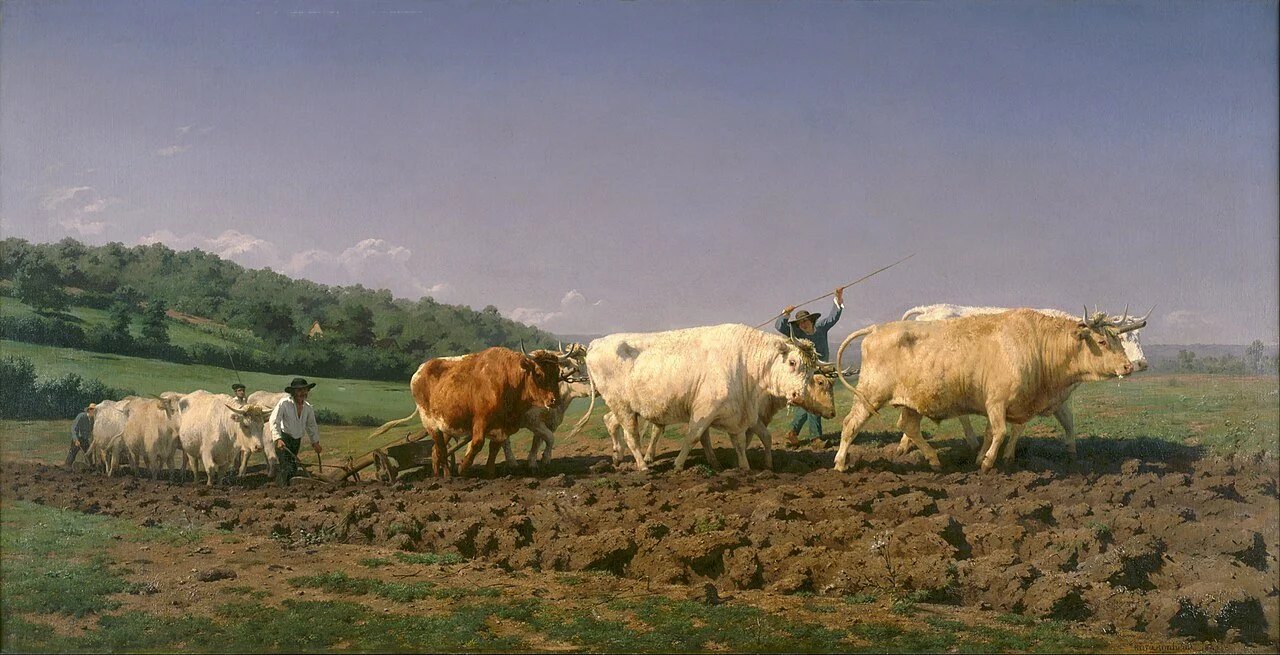
Ploughing in the Nivernais, 1849 painting, by French artist Rosa Bonheur.
Tracy Daub
7/9/23
University Presbyterian Church
Matthew 11:16-19, 25-30
YOKED
These colorful pieces of cloth, which pastors and sometimes other church leaders wear around our necks, are called stoles. Stoles have a symbolic meaning. They represent a yoke. Yokes are what farm animals, like oxen, used to wear around their necks to carry out the work of the farm—plowing, hauling, pulling, and so forth. The stole is a visible representation of the yoke of service all of us, not just clergy, all of us metaphorically wear in our calling to serve Christ.
If you have ever seen an oxen yoke up close, you will know how large and heavy they are. There is one hanging on the wall of my office—a big oxen yoke. It was given to me as a gift and I hang my stoles off it. I like the symbolism of that: one yoke serving to hold up the other yokes.
Sometimes I gaze at that oxen yoke and think about the animals that once bore the burden of wearing that large, heavy piece of equipment. Yokes are heavy things to bear—as are the yokes we bear in our lives. There are all manner of burdens we bear in our lives, things to which we are yoked. Maybe it’s a bad marriage or an unfulfilling job. Maybe we bear the weight of grief and sorrow. Or we bear the weight of destructive habits and behaviors we cannot break free from. Or we are yoked to our anger and bitterness over wrongs done to us. Yokes are heavy things to bear. And yet, Jesus tells us, “Take my yoke upon you, and learn from me . . . for my yoke is easy, and my burden is light.”
A lot of people in our society today are yoked to a way of life that often goes unquestioned—a way based on the need to earn enough, in order to have enough, in order to measure up enough. But since none of these objectives is ever fulfilled to our satisfaction, we are in a constant state of dissatisfaction and endless striving. And this quest leads to alienation from our own welfare and from one another. We work more so we become stressed and exhausted. We spend less time with the relationships that matter most to us. We move long distances from family and support systems in order to pursue our objectives. The pressures to achieve, to acquire, and to accomplish, to live out societal norms and standards of worldly success become a heavy burden to bear. But Jesus tells us, “Come to me, all you that are weary and are carrying heavy burdens, and I will give you rest . . . for I am gentle and humble in heart, and you will find rest for your souls.”
The Apostle Paul speaks about the yoke of sin from which none of us can break free. In his letter to the Roman community, Paul writes about the human conundrum which plagues all of us. “I do not understand my own actions,” he writes. “For I do not do what I want, but I do the very thing I hate.” This is the reality of human sin. We may not want to sin, we may even desire to behave a different way, but we still find ourselves acting in ways we do not want to act. We say something hurtful, we do something we regret, and then we are ashamed of ourselves and wonder, “Why did I say that? Why did I do that?” No matter how hard we try, we are unable to completely break free from sin.
Consider the complexity of living in the modern age of globalization where we are part of larger systems beyond our control. We may intend to live justly with others and with our world, but the clothes we buy, the food we eat, the garbage we throw away, the cars we drive may nevertheless involve us in practices of injustice. Our lives often reflect the contradiction between how we want to be and how we actually are. The Apostle Paul understood that we are captives to sin, that we are people bearing the burden of the heavy yoke called sin.
So how do we break free? Some people so chaff under the yokes of life that they endeavor to cast off all yokes and live unencumbered by restrictions or attachments. Free spirits, we call them. And such people have existed throughout history. Free spirits can be wonderfully creative people. Free spirits can teach us a lot about ourselves. They can help us gain fresh perspectives on the things we thought were important and help us see them in a new light. But I do not think that free spirits are really “free.” What does a life look like that has no attachments to other people? Or that bears no responsibility for anything or to any one? Such detachment does not make for healthy living. And a thriving society cannot exist if no one bore the yoke of responsibility. We are people who need attachments to one another. We need to be yoked to each other.
The Apostle Paul tells us that the rescue we seek from the yoke of sin and brokenness will not come from ourselves. Paul tells us that the rescue comes from God’s love revealed in Christ.
You see, true freedom is not about ridding ourselves of all yokes. It isn’t the fact of being yoked to something that is unhealthy—it’s what we choose to be yoked to that makes a difference.
Jesus does not say, “I will liberate you from all yokes.” Jesus said, “Take my yoke upon you, and learn from me . . . for my yoke is easy and my burden is light.”
Here is what Jesus is not saying. He is not saying that a life with him will be easy. He is not saying that a life walking his way will be free from problems, hurts, sorrows, or failure. What he is saying is that his yoke is light in ways that matter. Under Christ’s yoke, we can say goodbye to all our strivings to be loved, accepted, to be counted as worthy, to prove ourselves, to measure up—for we will live in an awareness that we already have received God’s love, forgiveness, and acceptance. We are already worthy. Under the yoke that comes from living Christ’s way, we will be freed from the anger and bitterness and judgments toward others and we can know a lightness that comes with forgiveness and grace.
All yokes are intended for work, for labor. And this is also true for the yoke of Christ. Labor is expected. But under Christ’s yoke, we will labor for different goals and different priorities than what the world values. And this kind of work brings rest to our souls.
Notice what a yoke does: it joins team members. There are two sides to a yoke. And who is the other person to whom we are yoked for labor: it’s Jesus. Jesus is the other member of the yoke. And our yoke is made easier and our burdens lighter because Christ is laboring beside us. And he invites us to learn from him as we work our way through this journey of life. “Learn from me,” he says, “for I am gentle and humble in heart.”
When we are faced with someone who has hurt us, Christ helps us do the labor of forgiving. When we are tempted by all of life’s excesses, when we are tempted by power and prestige, we can learn from the One who is humble in heart who teaches us that those are burdens not worth carrying.
When we are angry and bitter and hurt at how we have been treated by others, it is the Gentle One who walks with us and teaches us to travel another path.
When we are weighed down with sorrow or disappointment, Christ is shouldering the yoke, offering compassion, easing our burdens. When confronted with a wrong, when faced with an injustice, Christ joins us in the work of peace and justice.
Our burden is light not because life is easy but because Christ is yoked with us, laboring beside us. This is the yoke we choose: the way of Jesus Christ. And we choose this knowing that long before we choose God, God has already yoked Godself to us.