
Bad Guys and Bullies
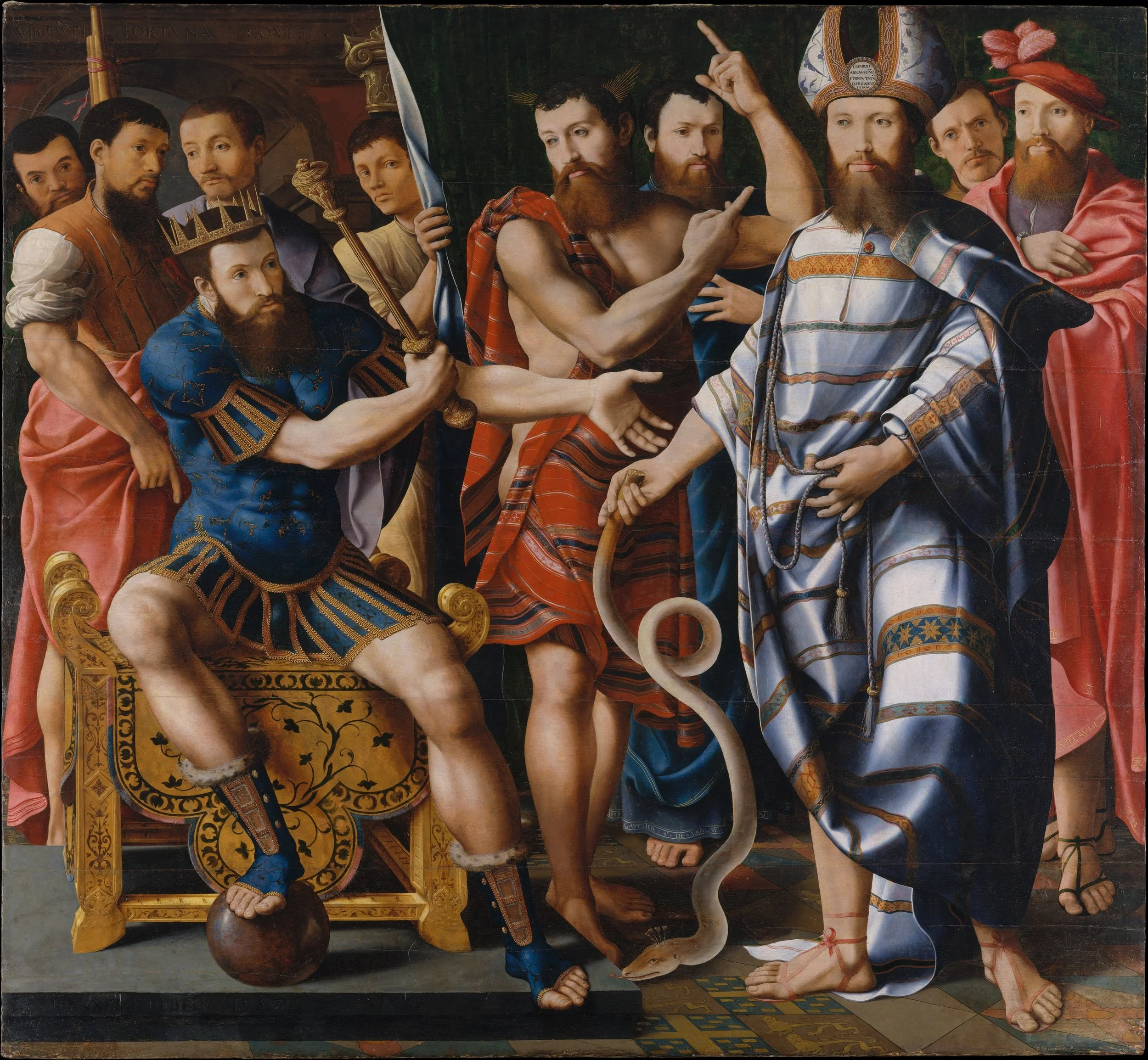
Moses and Aaron before Pharaoh: An Allegory of the Dinteville Family, 1537 painting, by the Master of the Dinteville Allegory.
Tracy Daub
8/27/23—University Presbyterian Church
BAD GUYS AND BULLIES
When my son Zachary was around four years old he became obsessed with a book about Peter Pan. It became required reading every night before bed. So, when I learned that the stage production of Peter Pan was coming to Shea’s, I immediately bought tickets for us to take him to see it. The audience was filled with lots of other children and their parents. And they all quieted down as the performance began. But when Captain Hook, the villain of the story, walked onto the stage for the first time, the audience erupted in a chorus of “boos.” The actor playing Captain Hook stopped, looked out at the audience and said, “I haven’t done anything yet!” Sometimes it is easy to spot the bad guy. It’s the dictator who invades a weaker country. It’s the bully at school who harasses and intimidates and demeans. It’s the unfair boss at work or the colleague who undermines your efforts. Or maybe the bad guy is the cancer that keeps on growing. Or the addiction that takes over your life. Bad guys and bullies come in many forms and shapes.
We find bad guys and bullies in our scripture readings. In the reading from Exodus, the bad guy is the Egyptian king, Pharaoh, who first enslaves the Hebrew people and imposes harsh living and working conditions upon them, and who then later plots to kill the Hebrew baby boys upon their birth. And the Egyptian people go along with their king. We are told in the scripture that the Egyptians became “ruthless” toward the Hebrew people. They become the bad guys who willingly do the bidding of their superior.
In truth, most of us have bad guys and bullies as ancestors—although we don’t always like to acknowledge that fact. Some of our ancestors may have enslaved other people and bought into the prevailing mindset and acted ruthlessly like the Egyptians we read about today. Maybe our ancestors participated in robbing native peoples of their land. Or maybe an ancestor was cruel to his wife, or abandoned her children, or engaged in criminal activity. Bad guys and bullies can likely be found in all families.
Some leaders in our nation want to downplay the ugly parts of American history, to alter or delete school curricula to avoid the unpleasant historical truths that some of our ancestors oppressed and stole from and killed other human beings and that our nation as a whole has gotten rich and strong through these very unjust policies and practices. Some of these leaders argue that teaching children these unpleasant truths will damage their fragile egos and their sense of self-esteem. But this argument arises from a mistaken belief that it is only other people who are the enemy—not us or our people. This mindset divides the world into good guys and bad guys. And since none of us want to be considered among the bad guys, we will do what we can to place ourselves in the good guy category. Other people are the enemy—not us or our people! We hear talk about enemies in Psalm 124. We hear the writer proclaim, “If it had not been the Lord who was on our side—let Israel now say—if it had not been the Lord who was on our side, when our enemies attacked us, then they would have swallowed us up alive.” The writer compares enemy forces to torrents of raging flood waters that would have swept us away under its power, if God had not been on our side.
So who was this threatening enemy the writer of the psalm speaks about? Well, the writer is vague about specifics. And what that does is it allows us to find our own situations of peril within this psalm. We may think about the enemies we have known—people who oppose us, people who have treated us or our ancestors unjustly, people who have wished us harm. Or, we might imagine the enemy as some kind of hardship or threat to our lives: the cancer, the depression, the addiction that endangered our wellbeing.
A deeper insight emerges as we contemplate the word used here in this psalm for "enemy." The Hebrew translation for the word enemy used here in Psalm 124 is the word adam. adam in Hebrew means “the human one." This is the word used to name the first human being created in the story of Genesis: Adam.
Psalm 124 identifies Adam is the enemy. And it points to the fact that the enemy, the real enemy we face, is our humanness. Adam rose up against us and attacked us--all those aspects of our humanness that lie in contrast to the ways of God: our hatred, prejudice, and intolerance. Our greed, selfishness, and bitterness. Our fears, our indifference, our violence. Adam rose up against us--the forces and ways and proclivities of our humanness. The writer of Psalm 124 imagines us trapped like little birds in a snare or in a cage from which we cannot escape. If it had not been for the Lord who was on our side, proclaims the psalmist, we would have been lost to these overwhelming and chaotic forces. We would have remained captured by the forces of our own misguided ways. For in the end, that is indeed what threatens all of us. That is the force that causes so much suffering and hurt and wrong in our world by one person or one group toward another--these overwhelming and chaotic and uncontrolled forces that lie within the human heart and soul and mind.
We have more than enough examples in our world and in the news of people succumbing to these uncontrolled forces. Clergy who abuse children. Global leaders who carry out genocides. Gunmen who open fire on community parades. We can spot the bad guys around us.
But we ourselves are not immune to the forces of Adam. All of us, the great and the small, are trapped in these cages of chaos and brokenness.
In 1961, the Nazi Adolph Eichmann went on trial in Jerusalem for war crimes. Eichmann was the Nazi official responsible for organizing the transportation of millions of Jews and others to concentration camps for extermination. The German philosopher, Hannah Arendt, attended his trial and wrote about how disturbed she was by Eichmann—but not for reasons that might be expected. Far from being the monster she expected, Arendt described Eichmann as rather bland and what she called “terrifyingly normal.” Working as a bureaucrat, Eichmann carried out his murderous task with calm efficiency, his focus being on furthering the goals of the regime and advancing his career. Arendt referred to these characteristics of Eichmann as “the banality of evil.” The banality of evil is the idea that evil does not always take on a villainous appearance. Rather, evil is perpetrated when immoral principles become normalized or commonplace—when ordinary people going about their ordinary everyday lives become complicit in systems or actions of harm. The banality of evil reminds us that bad guys and bullies come in many forms and shapes and sometimes, sometimes those shapes are us.
Christianity looks honestly at the human condition and acknowledges that darkness exists within us all. We participate in systems of oppression, knowingly and unknowingly. We say things that are harmful. We do things that are hurtful. We fail to act with compassion. We harbor prejudice and hatred. We are selfish and consume more than we need. And we squander blessings and talents. We are like birds trapped in a cage, in need of being rescued from our own chaotic forces of harm and selfishness and greed and anger and hatred which threaten our wellbeing, the wellbeing of others, and the wellbeing of our planet.
But in the face of these external and internal bad guys and bullies, the writer of the psalm reminds us of good news: God is on our side. God intervened and delivered us from adam, from the forces of our humanness, and set us free, like little birds from a cage, free to know and live a different kind of humanity. That is what we believe Jesus did for us. God does not abandon us to the enemy. And through God's mercy and love, we are saved from disaster, saved from a living death as well as a final death, saved from the raging torrents that threaten us. Through Christ, we have been released from the fowler’s snare, from captivity, and given a new way of living.
Each week we gather together to give thanks to God, who is on our side, and to give thanks for being freed from the enemy's control and power. We imagine what might have been if God hadn't been on our side. If God had not been on our side, then we would be burdened by the unbearable weight of guilt for our past actions. If God had not been on our side, we would be paralyzed by our fears and insecurities. If God had not been on our side, we would live selfishly, heedless of others needs or sufferings. If God had not been on our side, we would feel lost and alone in a hostile world. If God had not been on our side, anger and envy and bitterness would infest our hearts. If God had not been on our side, can you imagine what would have become of us? All week long we have these encounters with the forces of adam within us and outside of us, that pose dangers and hold us captive.
And we gather here on Sundays to recall with utter relief and gratitude that God was on our side, is on our side, that in the good news of Jesus Christ God has rescued us from the forces of chaos and disaster, and from captivity to our own adam tendencies. We are rescued so we may know a different life: a life knowing we are loved, a life of purpose, a life of generosity, a life of compassion and striving to forgive as we have been forgiven. We are freed from fear, from bitterness, from hatred. We are freed to love. We gather together on Sundays to recall that God desires to free us, that God can indeed free us, and that no matter how often we allow succumb to the chaotic forces, God remains on our side. There is indeed hope.
But as we are congratulating ourselves for having God on our side, we must recall something fundamental to the love of God revealed to us in Jesus Christ: God is on everyone's side. God is on the side of all humanity. God loves all humanity and desires to save us all from the forces of anarchy that threaten our wellbeing. As we read the newspapers and watch the news, the only hope we can have in this messed up world of pain and wrong and injustice, is that God is on our side--the side of humanity.
To be clear: God is not indifferent to injustice. Scriptures show us over and over again a portrait of a God who in particular stands with the oppressed and the vulnerable—and calls us to do likewise. But the message we have in Jesus Christ is that God desires for the transformation of all of humanity as we struggle with the forces that alienate and harm.
We who call ourselves Christians, we who acknowledge the bad guys in our ancestry and the bad guy forces that still reside within ourselves, we gather to confess to ourselves and one another that we cannot live the way of Adam because these human tendencies will engulf us and overpower us. Instead, we proclaim that our salvation is found in the saving love of God and the way of Jesus Christ. If it had not been the Lord who was on our side, your side, my side, our side, can you imagine what would become of us?