
The Pause and the Pilgrimage
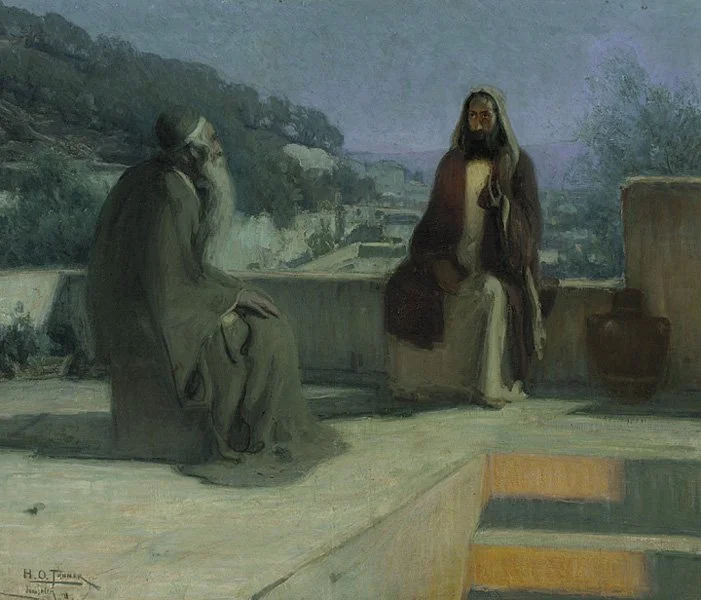
Nicodemus Visiting Christ, 1899 painting. Nicodemus (left) talking to Jesus, by Henry Ossawa Tanner.
Tracy Daub
9/10/23—University Presbyterian Church
THE PAUSE AND THE PILGRIMAGE
Psalm 121 is a psalm for people going on a pilgrimage. Now there is a distinction between a journey and a pilgrimage. Think about what makes the two different. A pilgrimage is more than just a journey. A pilgrimage is a journey that undertaken for religious or spiritual reasons. A pilgrimage includes the awareness of the divine. Pilgrimages can be done alone, but they are very often conducted with other people, other pilgrims. And another distinction about a pilgrimage is that the journey is just as important as the destination. People on a pilgrimage understand that the journey to their destination is a time for seeking God, a time for learning, a time for spiritual growth.
How many of you have ever participated in a pilgrimage? Raise your hands. Ok. I’m going to ask this question again but this time I want every one of you to raise your hands. How many of you have ever participated in a pilgrimage? All of us have! All of us who call ourselves Christians, who consider ourselves people of faith, view this life of ours as a pilgrimage. We aren’t just journeying from birth to death. We undertake this life’s journey as a spiritual journey with our God, a holy quest, where the journey itself has much to teach us about our faith, and the meaning of life, and the presence of God.
The writer of Psalm 121 was about to undertake a pilgrimage to Jerusalem. But before doing so, the writer considers the uncertainty of the journey. There will be difficulties on the journey—perhaps dangerous animals or even bandits and thieves on the road. There will be the hot sun, the need for water, slippery rocks on the edge of steep mountains. Hardships are likely to be part of this pilgrimage. And so the writer of our psalm asks a question in verse 1: “I lift up my eyes to the hills—from where will my help come?” That is the question. From where will my help come. And then in verse 2 we have the answer: “My help comes from the Lord, who made heaven and earth.”
We have the question which is immediately followed by the answer. But one commentator I read suggested that a faithful way of reciting Psalm 121 should include a long pause between verse 1 and verse 2—that when we recite this psalm we should include a long pause between the question, “from where will my help come,” (pause) and the answer, “my help comes from the Lord, who made heaven and earth.”
And that is because most of us live our lives between verse 1 and verse 2—between the questions that arise out of hardship and suffering and anxiety, and the answer found in God. For some of us the pause may be only a few hours or a few days. For others, the pause between the question and the answer may extend for months or even years. These questions of faith are varied. Where are you God? Why don’t you do something? How long must I suffer? Will my child live? Can my marriage be saved? Is our world doomed? Our questions to God arise out of our hardships and struggles and fears. As he hung on the cross, Jesus himself cried out his feelings of abandonment to God in a question of his own: my God, my God, why have you forsaken me?
As Christians we have not always been comfortable with such questions and when confronted with people’s profound questions of faith, we may rush quickly to verse 2 with answers like, “Everything happens for a reason,” or “It must be God’s will,” or “it will all work out.” First of all, these answers are not even truthful (everything does not happen for a reason, everything is not always God’s will, and things do not always work out), but they are not even faithful responses because they do not honor the pause—the space that is needed to ask questions, and to seek, and search, and reach for God. Some theologians speak about “faith seeking understanding.” Faith isn’t a possession but a journey toward understanding our God, and seeking the meaning of our lives, and learning how to live in harmony with God. And so the pause, the pause between the questions that arise from life and the answer found in God, the pause is an important part of our pilgrimage through life.
In fact, the pause is the pilgrimage. Our lives of faith are a holy journey through the pause between the questions and the answer. Our seeking, searching, reaching for God, is a holy quest.
Connie Michael, who lovingly cares for and hangs the banners in our sanctuary asked me if there was a particular banner that I would like to have hung on my last Sunday here at UPC. I chose the ones hanging here today which Cindy Hickey made some years ago. They are technically Advent banners for the Sundays before Christmas. These banners are based off of a scripture passage in Isaiah in which the people of God were in a time of great despair. They had been conquered by a foreign army and they imagined that their future was over and that their family tree, which went all the way back to King David’s father Jesse, this family tree had been cut down and was now just a dead stump. But the prophet Isaiah tells them that God will bring forth a shoot from the stump and will bring forth life and hope to their people. The tree will indeed live.
Early Christians imagined Jesus as that shoot coming forth from the dead tree stump, theone who gives life and hope to all people and to the dead-end places of our lives.
I’ve always found these banners so beautiful. I love the three-dimensional elements—the leaves and how it all ends with that three-dimensional flower representing Jesus and the new life he offers. And I also love how the branch coming off the stump reaches from one side of the chancel all the way to the other, and how our minds fill in the negative space of the gap between the two walls.
That gap, that’s the pause where most of us live. We live between the question found in the stump, the question of “where are you God,” in our times of despair and pain and struggle, and the answer found in Jesus’ love. We journey with one another in that space between the two walls—that’s the space we get to fill in with our lives, that beautiful and sacred space of reaching for God, searching and seeking for God.
The story about Nicodemus reveals someone who was searching and reaching and seeking for God. Nicodemus came to Jesus with a lot of questions. But he comes to Jesus under the cover of darkness because he is a religious leader, a person who is supposed to have all the answers. So he doesn’t really want anyone to see him coming to Jesus with all his questions.
And it’s clear that Nicodemus doesn’t really understand Jesus’ answers. He’s a lot like us in that respect. Jesus speaks to him in symbolic language, about being born again. Nicodemus doesn’t understand and thinks he means literally entering his mother’s womb again. Nicodemus seems pretty confused and by the end of this encounter, we don’t have any idea if Nicodemus has grasped anything Jesus has said.
But do you know where in John’s gospel Nicodemus shows up again? At the foot of the cross. Nicodemus is one of the people who helps take down Jesus’ body and prepares it for burial. Somewhere in that pause between that night-time visit to Jesus with all of his questions and his presence at the cross, Nicodemus has undertaken a pilgrimage. We don’t know the particulars of that journey, but he has clearly taken a spiritual journey with Jesus. How much Nicodemus now understands, whether all his questions have been answered, we don’t know. But his presence there at the cross, standing no longer in darkness but in the light of day among the soldiers who murdered Jesus, his presence there in indicates that even if he doesn’t understand everything Jesus has said or taught, he is embodying the answer. Sacred pilgrimage.
That’s what we have done with one another here at UPC. We have walked beside one another on a sacred pilgrimage of seeking and searching and reaching.
There is something holy in the pause. The pause through which we journey. Not needing to have all the answers but living in the questions, the searching, the seeking. And embodying the answer even if we don’t always understand the answer perfectly ourselves.
That’s what we have done here at UPC—we’ve been on a sacred pilgrimage through the pause. We’ve tried to embody the answer even when we haven’t fully understood it ourselves. To walk beside one another in the pause, the questions, the pain, the seeking.
I don’t think we have been afraid of the pause. I think we have embraced the pause, the journey, the searching, the seeking. And have tried to embody the answer even when we didn’t understand it fully ourselves.
All the ways we’ve embodied the answer even as we walk with one another through the questions. The pandemic, drive by parades for graduations. Partnering with another church in the wake of a racist mass shooting. A beautiful psalm of affirmation in God’s steadfast presence with us.
One commentator:
Too often Christians have been in the business of giving answers instead of joining one another in the pause where questions are welcomed, pain is acknowledged, and searching is valued.
Faith seeking understanding.
The pause is sometimes a place of grief. The pause offers us a place of discovery. The pause is a place of tension as we seek help. The pause is where we live a life of resistance to the cultural idols of wealth and success and privilege and power. Idols and their false promises. Most of us live somewhere between verse 1 and verse 2: between the question, “from where will my help come,” and the answer, “My help comes from the Lord, who made heaven and earth.”
Pilgrimages—journeys made together, value in the process not just the destination.
How many of you have gone on a pilgrimage?
Life is the great pilgrimage—we walk this together, seeking, searching, questioning, discerning the presence of God. This makes the journey holy—the awareness in the presence of the divine and the search we are undertaking.
These 21 years we have shared a pilgrimage together. We have journeyed in the pause between the hard and sometimes painful questions life presents us and the answer we find in God. We reach like this branch from the stump. We reach for God and the beauty of God’s love. And even when we didn’t have all the answers, we tried to embody the answer with our efforts to love and care and stand with one another.
Sacred pilgrimages are journeys through the pause—between the question and the answer. Friend who went through a time when he wasn’t sure what he believed any more. Church people said, that’s ok. We’ll do the believing for you until you can claim it yourself. Dangerous thing to offer pat answers, easy answers—to not value the questions, to not allow people to live in the pause.
The pause is the pilgrimage.
Mother Theresa, diaries revealed personal questioning, times when God seemed absent. But she kept on the pilgrimage, embodying the answer to the best she could, even when the answer was not always clear to her.
Nicodemus—came with lots of questions. Had a hard time understanding Jesus’ answers. As do we. But where does Nick show up again in the gospel of John-at the foot of the cross, in broad daylight this time.
What happened in the pause? Some kind of pilgrimage between the questions asked of Jesus under the cover of darkness and the man helping to bury Jesus in broad daylight.
Banner—our minds fill in the gap—the pause. The shoot reaches and reaches. That’s the journey, the pilgrimage through the pause.
These 21 years we have been a pilgrimage through the pause. Pandemic, membership decline, death of loved ones, mass shooting not far from this church,
Embody the answer even.
May the Lord keep your going out and your coming in from this time on and forever more.— which is another way of saying, “may God bless your pilgrimage.”
The gap, we live in that gap, that pause, the space in between the question of pain and struggle, and God’s answer. That’s the pilgrimage place.