
Communion Moments
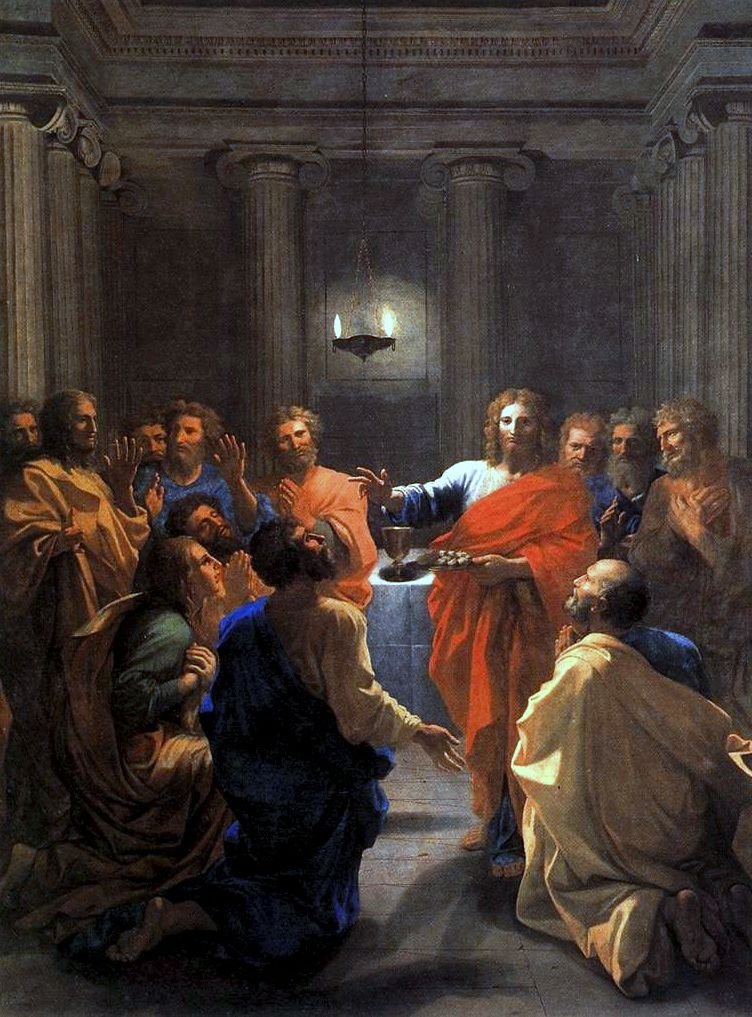
The Institution of the Eucharist, 1640 painting, by Nicolas Poussin.
Tracy Daub
9/3/23—University Presbyterian Church
Luke 5:27-32; John 6:1-14; 27-35
COMMUNION MOMENTS
By my calculations, I have presided over more than 520 communion services in my twenty-one and a half years here at UPC. That includes communion served once a month at both of our two worship services until after Covid when we changed to just a single service, and communion served at special services like Christmas Eve and Maundy Thursday, and communion served to church members in their home or in the hospital. And not one of those more than 520 celebrations of the Lord’s Supper ever felt routine. And that is because what takes place at communion is extraordinary. I can think of no other event or ritual in our society where people routinely show up to participate in such an intimate and vulnerable ritual—because communion is an intimate and vulnerable moment. At communion we walk to the table of grace side by side with people we maybe don’t know—strangers to us—and with people we maybe don’t even like, to receive God’s grace for our lives, and to re-commit ourselves to living God’s grace toward one another. Our very participation in the Lord’s Supper is a public declaration that our lives are not in great shape and so we need what is offered here, and that we will endeavor to love all the other terribly flawed folks around us. And that makes every communion moment something extraordinary, something sacred.
Of course, there are some moments among those more than 520 communion occasions that do stand out in my memory. I’ve shared some of these stories with you before, but I share them again because some of them are funny and some of them are poignant, and they offer little illuminations into the profound truths we find here at the Lord’s Table.
Like the time when someone purchased incredibly crumbly bread for communion. This was back in the pre-Covid days when we took communion by breaking off pieces of bread from a common loaf and then we dipped them in the chalice of grape juice. On this occasion with the crumbly bread, by the time the two lines of worshippers had finished coming forward to receive the sacrament, floor around us servers was practically ankle deep with crumbs and it looked as if we had been caught in a sudden snow storm. Jerilyn Hickey was holding the chalice beside me, and when she turned to serve me communion, I looked into the cup to see a mass of floating, soggy pieces of bread. "Kind of soupy, isn't it?" I whispered to her, and we both burst into laughter. She told me later that she had watched as worshipers had dipped their bread into the cup, only to come up with nothing at all left at the ends of their fingers.
Sometimes our lives are crumbly and falling to pieces. And it is precisely at such times that we are invited to come to the Table--the Table of God’s love and grace which offers healing and hope and forgiveness. And around us we see others whose lives are in fragments for any number of reasons. Jesus instruct his disciples about what to do with the crumbs from their communion moment there by the Sea of Galilee. He says, “Gather up the fragments left over so that nothing may be lost.” That’s what Jesus was doing when he ate with tax collectors and sinners: he was gathering them up so that no one was lost. That’s what communion teaches us. None of us is lost to God’s love or grace. We learn this here at the Table so we can practice it with others. Gather them up, so that no one is lost.
One Sunday, Jude Hammer was setting up the communion table for the Lord's Supper when she realized that there was no loaf of bread for the service. So after she had set the whole table with everything else but the bread, she ran to the store to buy a loaf of bread for the service. But before she left, she did something very thoughtful. Realizing that I would probably come along and see the communion table all set for the service but not see any bread, she left a thoughtful note right on the plate that would hold the bread. It read: "Don't panic. Bread on the way."
I've saved this note all these years because it totally captures the message of communion. We need the bread because we do panic. Life fills us with panic and fear and sorrow. In our fear, we need the bread. In our grief, we need the bread. In our conflict with others, we need the bread. We need the bread, the bread which Jesus supplies, so that we will know that we are loved and so we will know to love one another. We need the bread to know that we are forgiven, and then so we will know to forgive. We need the bread so that we know that we are not alone in hard and scary times, and then so we will know to be with one another in hard and scary times. Jesus tells us, “I am the bread of life. Whoever comes to me will never be hungry, and whoever believes in me will never be thirsty.” In Jesus we are assured that bread is on the way.
As most of us know, the sacrament of communion recalls Jesus’ last supper with his disciples. We’ve all seen the paintings of Jesus at the table with the twelve disciples gathered around him. But as our readings today reveal, Jesus celebrated communion with all kinds of people, in all kinds of settings, long before he ate that final meal with his disciples. Whether it was with tax collectors and other less that respectable people, or with large crowds along the Sea of Galilee, or with women and children, Jesus turned communion into a moveable feast. Communion became any occasion where Jesus could offer healing love, acceptance, hope, and forgiveness, where he could strengthen people’s ties to God and to one another.
And that means that communion is not just a ritual we perform here in the sanctuary. The point of doing this ritual here is to open our eyes and hearts to the ways communion moments show up out there, in our ordinary lives. Communion here is a practice run, a dress rehearsal for the ways it will show up in our daily lives and for the opportunities we will be given to practice God’s radical love and hospitality.
I know that communion moments take place in your life. Just about every single day offers us communion moments, if we pay attention. Maybe they happen with family members at the kitchen table, or eating a MacDonalds hamburger with your granddaughter in the front seat of your car. Maybe they don’t even include food, but are moments of reconciliation and forgiveness, or an occasion of kindness toward a stranger, or an opportunity to show solidarity and compassion. What communion moments have in common is the element of grace, of strengthening ties and bonds with others, in extending compassion, in receiving and giving love and dignity.
Over these years we here at UPC have shared so many communion moments and only some of them have taken place in this sanctuary. I think about the Sunday morning we learned that Roberta Henderson was in the hospital and had very little time left to live. After the service was over, I drove to the hospital and walked into Roberta’s ICU room to find Howard Henry, Lee Ann Grace, and Mary Jean Conibear already there at Roberta’s bedside. And they were singing hymns to Roberta as she lay unconscious, singing hymns to send her home.
Our communion moments have been in our laughter around the table at a committee meeting, and in offering a ride to the doctors, and in knitting prayer shawls together, and in standing around munching cookies after a funeral—all those ordinary and yet deeply sacred moments in which God’s grace and love have been served to one another.
In the early days of the pandemic when we were all cut off from one another, Ginna Coon undertook a ministry of taking communion elements to people’s houses before the Sunday service. Her dedication to the members of UPC and their worship needs was so admirable. So too was her innovation regarding the communion elements themselves. I recall the little bag she dropped off at my house containing a couple of cookies and two cans of beer! Communion was served!
All those potluck dinners we’ve held downstairs are communion moments, where bonds are strengthened and people are nourished in body and soul. It is my belief that every church potluck is really best understood as a recreation of the biblical story of the feeding of the multitudes with five loaves and two fish. Think about it: at a potluck we never know how much food will be supplied or how many people will show up. And yet, it always works out. There is always enough. And there is always room for one more. That’s the story of the loaves and fishes. I can recall one potluck years back where most of the dishes that were brought to the meal ended up being desserts. But you know what? I heard no complaints!
When we celebrate the Lord’s Supper, we recall how Jesus took ordinary elements—the bread and the wine—and used them in an extraordinary way. These ordinary elements were used to symbolize God’s love and mercy, broken and shared with us and for us. But you know what? The most important ordinary element in communion is not the bread or the wine. The most important ordinary element is you—you and your life, which God blesses, and God shares, and God uses in extraordinary ways. At communion, you are the ordinary turned extraordinary. Your life becomes the sacred element that receives God’s blessing. Your life becomes that sacred element when it is broken and shared for others.
In our scripture today, Jesus tantalizes the crowds with a description of the bread from heaven which God supplies—a bread, which he says, gives life to the world. Now when you hear about something so amazing and so good, you naturally want to know where and how you can get your hands on it. The crowd says to Jesus, “Sir, give us this bread always.” Give us this bread always.
It was Christmas Eve many years ago and the time came in the service for us to celebrate communion. Folks were coming forward to receive the sacrament when I saw Ginna leading her cousin Susie forward. Susie, as some of us will remember, would sometimes accompany Ginna to church before her health declined. Susie is blind and cognitively impaired and she was known to bless our congregation with her vigorous and enthusiastic singing of the hymns. On this Christmas Eve, as Ginna led her forward to receive communion, Susie cried out in her booming voice, “Is it time for the bread, Ginna? Ginna, is it time for the bread.” Ginna tried to quiet Susie. “Yes, shhh,” she whispered, “yes.”
“O good!” Susie exclaimed. “Because I’m so hungry for it!”
We are all hungry for it. The world is hungry for it. We are hungry for God’s love and grace. We are hungry for healing and hope. We are hungry for kindness and for peace. We are hungry for the bread of life. We have found the source of goodness and so we come to the table praying, “Lord, give us this bread always.”